In This Article
There are a few reasons you might be comparing Odoo and Epicor: You could be choosing your first ERP system, or maybe you’re using Epicor already but want to move to a cutting-edge system with far more capabilities.
In this article, we’ll compare Odoo vs. Epicor to help you make the best decision.
What Is ERP?
An enterprise resource planning (ERP) system connects your core business processes, from accounting to inventory management, customer relationship management (CRM), and beyond. The software collects information from across departments into a central database for better reporting and collaboration. The best cloud-based ERP systems also automate processes and have business intelligence tools that offer rich insights into your business’s performance.
Odoo vs. Epicor: An Overview
Odoo was built in the cloud with a suite of tightly integrated functionalities that can equip your company to confidently change and grow, no matter the industry. By contrast, Epicor is newer to the cloud game, offering disjointed ERP aimed at specific industries. Odoo’s modular approach — supported by Odoo Online, Odoo.sh, and its global partner ecosystem — provides a total solution in a single, integrated platform. It gets you up and running quickly and is built on leading practices developed from thousands of implementations. KPIs, workflows, reports, and value-driven dashboards meet the day-to-day and strategic needs of all key roles within your company — from Day 1.
Odoo
Odoo’s open-source, modular ERP system is built on a single, integrated data model that supports finance, supply chain, manufacturing, CRM, HR, ecommerce, and other critical business functions without requiring complex integrations between separate systems. In other words, Odoo provides a unified platform that grows with your business needs, ensuring that processes remain connected and data stays consistent no matter how much your organization evolves.
Epicor
Epicor started overhauling all three main Epicor Software products in 2015 and did not finish until 2019, according to their CEO. Thus, many of its customers still run on-premises ERP systems. Epicor tends to add functionality through partner solutions or add-on modules that require integrations.
Product Maturity and History
Odoo was founded in 2005 by Belgian entrepreneur Fabien Pinckaers as an open-source ERP project originally called TinyERP. A few years later, it was renamed OpenERP as the platform expanded in scope. In 2014, the company rebranded again as Odoo to reflect its evolution beyond ERP into a complete suite of integrated business applications. Today, Odoo serves more than 12 million users worldwide through both its free Community edition and commercial Enterprise offering.
Epicor started in 1984 as Platinum Software Corporation, an accounting software company. Platinum went public in 1992, acquired other software businesses, and changed its name to Epicor in 1999.
Odoo vs. Epicor
In addition to a singular focus on a cloud-based solution, Odoo has key features that Epicor doesn’t.
Epicor lacks native CRM, ecommerce, and tax management features compared to Odoo, which was created as an “all-in-one” solution that can manage all those functions.
Many existing Epicor customers are using Microsoft SQL Server Reporting Services (SSRS) or SAP Crystal Reports. Meanwhile, Odoo comes with hundreds of reports and dashboards for real-time insights on your business. You can build new and change included reports in Odoo with clicks, not code.
More details on the difference between Odoo vs. Epicor:
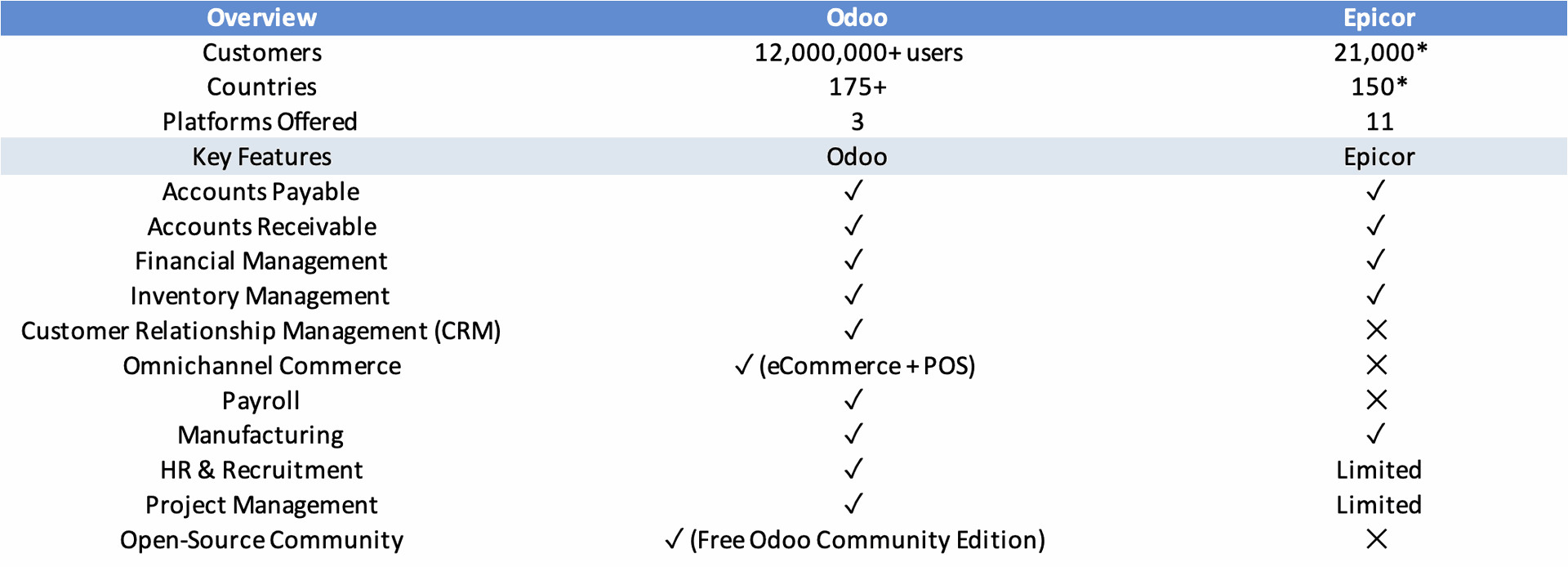
*According to 2022 data from Epicor’s website
**Native to the ERP; not requiring different technology or separate databases
Implementation Considerations
Several customers with prior experience with Epicor have mentioned heavy implementation lifts and additional costs due to adjusted timelines and little out of the box products. Odoo implementations, by contrast, are simplified by its modular, app-based design. Businesses can start with out-of-the-box applications—such as Accounting, CRM, Inventory, or HR—that come with preconfigured workflows, dashboards, and KPIs. With Odoo Studio and its open-source ecosystem, companies can further tailor processes without heavy coding or long consulting projects. This staged and modular approach allows teams to go live quickly with the essentials, while retaining the flexibility to add more applications or customizations as the business grows—without the heavy costs often associated with Epicor implementations.
Database and Architecture Considerations
Many of the Epicor modules offered today were acquired solutions not built natively on Epicor’s ERP platforms, or are solutions “powered by” 3rd party vendors. These modules then require integration and can create a more complex system. Common with legacy on-premise and hosted cloud solutions, companies can experience delayed or painful product upgrades and costly and cumbersome integrations or customizations.
Odoo focuses its development resources on one unified, modular platform. As a SaaS offering with Odoo Online, all customers run on the same version thanks to automatic annual upgrades, and customizations created with Odoo Studio or Python development carry over with each upgrade.Odoo’s new applications (e.g. eCommerce, Point of Sale, Marketing Automation, Field Service, etc.) are built natively on the Odoo platform, not requiring additional integration.
Platform and Integration Capabilities
Epicor’s platforms are narrowly focused: For example, Epicor Kinetic (formerly Epicor ERP) targets manufacturing, not distribution or retail. If your manufacturing business runs Epicor and wants to enter the retail and/or ecommerce space, for example, you’ll likely need to implement a separate Epicor product.
Odoo’s platform allows you to easily add functionality for more industries and sales channels. For example, when Epicor’s limitations prevented distributor E-Z LOK from launching an ecommerce channel, E-Z LOK switched to Odoo. It now runs a fully integrated ecommerce site with Odoo Website and eCommerce apps, and fulfills orders faster than it did with Epicor.
Odoo also makes it simple to add and manage local and international subsidiaries with real-time and automatic financial consolidations. Consolidations in Epicor require a submodule at an extra cost, as well as manual work.
Partners and Ecosystems
Epicor has a comparatively small independent software vendor (ISV) partner network, so customers usually create custom integrations to outside tools.
Odoo has a broad ecosystem of partners and community developers that extend the platform’s value, with over 30,000 applications available in the Odoo App Store.
Support Services
In addition to online support, Odoo provides extensive documentation, a searchable knowledge base, and an active community forum with over 2 million posts from users and developers worldwide. For customers that want to proactively optimize their solution with a team of experts, Odoo offers Success Packs and dedicated support services delivered directly by Odoo S.A. or through its global partner network.
Epicor’s EpicCare support offering, which comes standard, provides online and phone support, a knowledge base, and customer communities.
Odoo vs. Epicor Pricing
Odoo Community Pricing and Deployment
Odoo Community stands out with its free and open-source model. There are no expensive license fees, and businesses can choose the deployment method that fits them best—on-premise or cloud—while maintaining full control over their system and data. This flexibility helps avoid vendor lock-in and keeps overall costs predictable.
By contrast, Epicor comes with higher total costs. Beyond the base software, companies must factor in implementation, customization, and ongoing system maintenance, as well as third-party apps (for example, many Epicor users add an external CRM right away).
Maintenance and Extensibility Like any ERP, Odoo Community requires implementation and upkeep, but the difference is in its ecosystem. With a large open-source community and 3,000+ active partners worldwide, users gain access to thousands of free modules and collective support, keeping the total cost of ownership lower. Epicor customers, however, often rely solely on official or limited partner resources, making upgrades and extensions more rigid and costly.